Wednesday, August 12, 2020

Important Tips For Running Good Convention Games

Convention games are a different experience from a home game. First the players probably don’t know you. Second the players probably don’t know each other. Finally and most importantly there is a finite amount of time the game has to fit in. These aren’t the only differences but by being aware of these differences you can set yourself up to ensure the game runs smoothly and your players have fun. 


What does it mean if the players don’t know you? It largely means that the trust in you, the DM, isn’t as strong as it would be with a group of friends. One way to mitigate this is to tell your players a little about you and what you like most about DMing. Don’t spend more than a few minutes on this, but it can help break the ice when setting things up at the table. To take it a step further, discuss what options are available in case a player is uncomfortable.  One of the easiest and most common choices is the X-card.  Now, there is no need to dwell on it,  just explain “if there is a problem with the game or anything that bothers you, tap this and I’ll do my best to change the subject.” On the other hand, if things are going well and they’d like more of that style of play then they can raise the O-card. If you are playing online, a player could privately message you an X or an O and provide additional details to help keep things moving and keep everyone happy.


The second hurdle that a convention DM has that most home games don’t have, or don’t have for long, is the players don’t know each other. To go along with the players not knowing each other in many organized play events the players may not have the characters available to make a balanced party. An unbalanced party or a balanced party that doesn’t know how to synergize and work together means that you, the DM, need to balance encounters as you learn the player’s skill. You will also need to ensure that an encounter doesn’t stall and take up the entire adventure, preventing the players from seeing the whole story. It is also important to not take combat too far and actively try to kill the PCs, instead give them the illusion of potential failure.   The resources and GM course correction available in a home game are not readily available in organized play and joining a random game should be fun not life threatening to a PC that has taken many hours to level and may still have adventures to play at the convention that are level specific. The best advice for avoiding these pitfalls is to have experience. But to get experience you have to try and learn what works for you.  Lacking experience it is critically important you read the adventure and think about what a group of players might have trouble with if they don’t have the right kinds of spell casters, don’t have enough high damage output, or charismatic or sneaky characters. These are just a few examples to keep in mind but when you read an encounter ask yourself what is the story here and what can be done to make experiencing that story flexible? Especially since going back to town regrouping and hiring some locals might not be available for the party or something the players have been taught to consider.


The third and most pressing problem that a convention DM has to deal with is that there is a time limit the adventure has to fit in. In a home game if the adventure runs long you can pick up again in the same place next week. Or have the party return to town heal up, gather new supplies, and try to conquer the dungeon again. At a convention this is the players’ only chance to experience this chapter in what may be a larger story; don’t rob them of that and make them confused for the next DM to have to fix. Staying within your time limit is also important because the convention has scheduled durations for events and often players will have another game starting just after yours is set to finish or the space you are using is booked for another game after yours.  Be respectful and end on time. Just remember to tell a complete adventure during that time. The players are at your event to play D&D which means they expect a story of daring adventure that is “complete” and fulfilling. Keep the game moving and decide what encounters may need to be cut short or omitted to to help the players get through the adventure in the allotted time. The best advice I can offer is read the adventure and understand what is important. Make sure you understand the structure of the story and where important details are so if there is fat to trim or combats to abbreviate you’ve given them the clues and experience to understand how things advance and reach fruition at the end.  That may mean narrating the resolution of a scene that is running too long, allowing alternative methods of advancing the plot with creative descriptions of skill use, or even just asking the players what they plan is and allowing it to work as far as the next part of the adventure. The idea with this is to ensure the players see and understand the plot beats and know the story they are playing in and helping to create. This allows everyone to experience the adventure and get the rewards they deserve. 


With these differences in mind the game should warm up faster and help everyone enjoy themselves. Remember the golden rule that as the Dungeon Master it is your job to provide a safe environment and help everyone have fun. These players are at your table to experience an adventure. There is no reason to hide that adventure or story nor make it so difficult, complex, or deadly that they can’t experience the story in the allotted time. Everyone should have fun and be able to tell a great story at the end. Which is a good rule of thumb for every game session at a convention and at home.  Pax Ludos!


If you have your own experience, additional advice, or questions leave a comment below.


Monday, March 9, 2020

The Campaign Pitch or How to see what your players are interested in

Red background with an Imperial eagle surrounded by a laurel wreath with SPQR written bellow it.
The Stellaran nation is ripping itself to shreds. “The Dictatrix is dead! Long live the Republic.” cry the traditionalists after the assassination. “Burn the Senate and restore Imperial glory” is the rallying cry of the Imperialists. The vassal states see this as a chance for freedom while everyone else sees the opportunity for conquest and riches. The dogs of war have been set loose. You can choose a side or strike out to build a new power in the world.


Catchy, right? Well I think it is and it will be one of my campaign pitches for a game in a world that will lean heavily on classic tropes with the added menace of a Rome parallel Stella. If my players choose to play this campaign. I hope to offer them a few choices once my current campaign ends.

While thinking about what interests me for my next campaign. I wanted to write out what a starting pitch for a fantasy RPG campaign should look like. A campaign has to catch your players and GMs fancy. If people don’t like the theme, ideals, or style of play then you are going to have players constantly butting up against what you want to run and what they want to do which can be frustrating.

This means it needs a catalyst that drives conflict and shakes up the status quo so the players can step in and set things right or shape the world in a new way. A threat of war, or an actual one, are classic examples. These events make heroes and give them places where their actions ripple across the world amplifying their effects and grandeur.

It should give the players options. In my example above the players could be trying to set the Republic back on track, they could be involved in establishing the empire as an even greater nation, they could be vassal state citizens fighting for the freedom of their people, or they could be barbarians seeking fortune, glory, and a place to burn or conquer.

To be clear, different PCs could have different agendas. But I would try to look for ways to keep the party from having bother Republicans and Imperialists so I can cast the other side as a decadent self serving power hungry faction that must be stopped.

It should also leave enough room that you can shift the focus a bit if the party loses interest. An example would be if the campaign started with lots of political intrigue but after a while they decide they want dungeon crawling or other fights. The campaign can shift towards protecting Stella from outside attacks or finding artefacts to bolster a right to leadership or even to stop the treacherous acts of another faction.

The political cartoon that gave rise to the name Gerrymandering
It may sound democratic bu I'm not above gerrymandering.
I could run this in many different systems. I will probably run it in 13th Age’s Archmage system or 5E using rules and monsters from the new Theros book and Odyssey of the Dragon Lords. By hooking my players on the plot I could potentially run this in a system that my players are less comfortable with because the premise excites them.

My goal here is to find out what excites my players and me. It also gives me the chance to think about all the cool things I’d love to run or play. The goal is to make this a short elevator pitch that everyone will read. Once the players have picked a campaign I’ll work to flesh the campaign premise out into a couple of pages. This will let me add some details to inspire the players when they are creating their characters. Give them a bit more grounding in the campaign and hopefully inspire them to flesh out parts of the game as well to help keep them involved.

For anyone interested my other ideas, which still need to be refined, are:

“Behold a new god is born!” proclaim the oracles around the world. Some claim she will bring a new age of enlightenment to the world. Others cry she will destroy it while making something deserving of her. Atop of the Spire of the World the babe waits to be shown the world she has inherited and will grow up to make her decision over. The best and worst of are amassing armies to claim the land around the spire and take the god child so they can mold her into a weapon or salvation. Will you sign up with a cause or strike out on your own to shape destiny?

The dead rise. It is spoken about behind churches and among gravediggers. Even miners claim they can hear the shuffling tramp and ghoulish armies. Some even claim small villages and farmsteads have been overtaken and destroyed by this curse, or worse they’ve been dragged below to feed something worse.

The swamps are dark and cold. Hidden creatures stalk the darkness. It was slow at first but more and more have gone missing….are you ready to save Saltmarsh?

Monday, March 2, 2020

What's in a campaign?

What is a campaign? In D&D that question can have many answers and I think I'm going to change my approach the next time I start something new.

Treasure Map1) a campaign is a series of adventures that a party undertakes. It starts at low level and proceeds as the players level up. Eventually the PCs become leaders and the party decides if they want to continue or start something over.  If they continue then new adventurers the followers do a lot of the grunt work and the leaders do more nation building and help flesh our parts of the campaign world.  This goes on and on until interest is lost. Then new players are brought in along side some long term players or it is revived with new players but the world is the same the campaign continues.

2) There is a mega adventure that the party will undertake they will start at low level and proceed until the evil is stopped. WotC is making these campaign adventures as books. Almost every one of these is a self contained campaign. Sometimes one campaign book bleeds into another. But that seems to be the exception more than the rule.

3) A campaign is a goal the PCs set out to do. There might be several small adventures or just a large dungeon crawl that takes several attempts to complete. Think of this like a season in a television show. The season is a campaign and the series is a collection of campaigns.

I usually run something closer to option 1 that hybrids into 2 a little bit. I have an end goal the PCs can attain and once the PCs are sufficiently established as leaders they retire. Then I start up a new campaign at low level. The high level PCs are generally NPCs but they can be brought back in.

But I'm really leaning towards making Option 3 my new default even in a sandbox campaign. Give the PCs many options of things to do but once they start dealing with a village or large dungeon that is a campaign. After the campaign is over the PCs have a long period of "down time" as described in 5E and maybe as described by Matt Coleville. I'll take a month off work with the players off line and then start the process over again based on what the PCs want to do.


Also the formatting on my last post was went weird after I published it and made an edit. I've fixed that post if you want to try and read it.

Pax ludi and have fun.

Sunday, February 23, 2020

To Fudge or Not to Fudge Dice Rolls

So over the past week a lot of digital ink has been spilled on twitter about fudgin dice. There I tried to voice
my opinions but it felt disjointed. So I thought I’d share a bit more detail here and be able to point people
towards it when this conversation rears up again. 


I try not to fudge dice. I don’t like it when DMs do it to me and I don’t like doing it to my players.  Dice are
there to determine things I want taken out of my or my players control. When we roll dice in an RPG it is
done  to add dramatic tension of not knowing the result, to be an “arbiter of fairness” in combat, and
prevent the GM or players from just winning. 


So if I am going to fudge the dice I am violating one of these three statements for why roll the dice. If I am
going to fudge the dice I should ask myself “Why are you fudging the dice and was it the right reason or
should I have avoided a dice roll entirely?” In the heat of a gaming session it can be hard to be this
introspective. So note it down or ask a player to make a note1 for you and keep the game running. 


Three main reasons I want to fudge dice and usually there are better work arounds that I should have used.
1) The PCs should have succeeded at this roll or needed to succeed at the roll for the adventure to
continue.
2) The monster is really tough and the players should be hitting more or the monster should be hitting
less or vice versa.
3) I backed myself into a corner and ratcheted things up to far and now I’m going to see a PC killed over
something stupid like a series of jumps across buildings that just got too hard and now she’s going
to fail and fall.


In the first case. The right answer is to not do that. If the players should succeed let them do it without the
roll. Or better yet use the roll to see if there are complications that will happen later on. This is referred to
in some games as “Failing Forward”2. A good example is the players toss a crime scene looking for clues.
They ultimately need to find a clue here to keep the adventure moving and it will break things if they don’t
get the clue and frustrate me and the players. So give them the clue. But use the dice rolls to see if there
are other complications that arise. Maybe poor rolls mean they find the clue but it can’t be used as
evidence. Or they know contact poison was used because they managed to also come in contact with it.
Or the players take so long to complete the search another crime has been committed or the criminals
have shown up to clean up the scene and now there is a fight. These are some examples. But all ideas I
might jot down in adventures notes as ways to “fail forward”. The worse the players roll the more difficult
the complication is to overcome or the more time lost. But at least the adventure can move forward.
When running a published adventure this can be harder to remember to do or determine ways to
incorporate the concept but it is worth taking the prep time to think about.


The second instance of wanting to fudge dice is when a monster proves too difficult. This is also a harder
case for me to fudge my dice. This is because I always try to roll my dice in front of the players. They
can see what my dice are doing so if the dice are hot the players can see I’m not being a jerk chance
just isn’t on their side and my dice are cold (which seems to happen more frequently than I would like)
they can see that I’m not pulling punches to protect them. However, there are times when I’m testing a
new monster or trying something different that the creatures AC or attack is just too high. Rather than
fudge the dice and let the players hit a little more often or have my monster miss more frequently. I
would rather take the time to reduce the monster’s AC or attack roll. Maybe I’d even tie it to something
creative a player did to describe an attack or just in response to the monster getting hit.  “When your
warhammer slams the orc chieftain you know its helm off. It seems stunned for a moment.” If my players
have pegged the creatures AC at this point I might tell them the new AC of the monster at this point. If t
hey haven’t figured it out yet I would keep it secret so they can keep guessing. The same would be true
if I had lowered the attack. Another option I use less frequently would be to have imposed a condition like
dazed on the monster for a round or two. But that is something I would certainly save for clever actions or
descriptions from the players.


The final instance is the hardest to identify and fix. It usually happens because I’m running the game and
my players have left any semblance of why I had planned for. We are not in uncharted territory and the
dice are helping to tell the story but also based on what the PCs are doing and how the dice are going
they also give me time to think about what might be next. So I don’t always realize when there are critical
rolls about to happen that really shouldn’t be left entirely to chance and by the time I do a PC is
plummeting to their death or I or the PCs are backed into a corner and people are starting to get
frustrated. During this time I often have to call a break on the game grab something to drink and sit back
down after 5 minutes. We recap what has happened, what is going on, and what the PC are trying to do.
During this step back from the immediate action I can get my bearing. Then I can figure out what the
forward looks like and understand what failure might be as well. Now I’m back on track with determining
ways to have the party fail forward. At times like this I might even lean on my players and ask them to
provide me with ideas for what failure looks like and determine how they move forward from here.  It isn’t
my favorite style of running the game but sometimes you take a messy solution and keep things moving
over ruining a whole session because I couldn’t plan it all out perfectly.


In summary (tldnr) there are more options for GMs to use beyond fudging dice. They might have the
same effect but feel less capricious and are applied evenly across all players and actions. So think
about why you fudge your dice and try to use other methods in the future. At the very least it will help
stretch your thoughts about the game’s rules and how to apply them to odd situations. I hope it helps.


Pax ludi and have fun.


1 I try to get my players to keep track of things I may want to revisit later rather than stopping the game
to take the note myself.  It usually consists of me saying something like “X, please send me an email
about the ruling I just made. To check if there is a rule we should have used.”

2 Thanks Robin D. Laws I believe my first contact with this idea was reading about Gumshoe. I started to
get it while running 13th Age by Rob Heinsoo.

Saturday, December 14, 2019

My RPG goals for 2020

I have not posted much here.  But I think I should. Or at least I should more often then twice a year. So in preparation for 2020 I am writing this post. It will be my "pledge" to write more.  Some of it will be about mini painting. Some of it will be about games I am in. Some of it will be my ideas and reviews of RPG material. With luck all this extra writing will prompt me into even writing a few more details about a game and setting I'd like to elaborate on.

I know this blog isn't frequent enough to have regular readers but for those of you following it be ready to hear more from me.

Cheers,
Matt

Monday, May 28, 2018

Psionic Sub Classes for 5E


I've been watching The Mike Mearls Happy Fun Hour, lately. He's been showing off some of his design process a lot of it full of idea boards just tossed into a word document and him speaking about the story and feeling he wants represented in play. This is a messy process and it is inspiring to see such a prominent lead do this kind of work in public in an hour. He doesn't always finish what he starts in an hour but he makes a fair bit of progress. A few episodes ago he started looking at creating a psion like sub-class for Wizards. He made enough progress and had enough potential he went on to do this for the fighter and now the monk.


But, enough about how I feel about the videos. The import part is that it has inspired me to think about design. Largely in part because during a few episodes Mike mentioned that there was a design element for Barbarians thought of as the Nova Barbarian. The idea being when the Barbarian stops raging there is an affect that happens. What the design team found out was that it prompted players to enter rages and then end them the next turn to get that effect. This wasn't satisfying and didn't really feel like a barbarian tactic, so it was scrapped. I was thinking about this concept and wanted to try and make it work. That got me on the path to thinking of a barbarian that rages and while raging builds up a pool of damage that is dealt to everyone around her at the end of the rage. The longer the barbarian rages the more damage she will be able to do. But, I couldn't figure out a theme for it until Mike started the psionic sub class series. It made a lot of sense for this Nova Barbarian to be psionic themed. In addition it got me thinking of other classes and concepts to explore. So before showing off my Psionic Barbarian Path, the Path of the Telekinetic. I want to outline a few other sub class and psionic ideas in general. Mostly so when Mike beats me to developing them I can say I tried.

TelekineticistBarbarian - This class' psionic power is fueled by raw emotion. They are the most terrifying kind of wild talent because thing move and jump around them and often they will never control or understand their power. Those that do are terrible and dangerous because they've learned to tap into their internal turmoil and inflict it physically upon the world.


Mind Spiker - Rogue - This rogues sneak attack does psychic damage. At higher levels it causes confusion and maybe even lets them interrogate the minds of people outside of combat. In addition the mind spiker might even be able to render himself invisible to observers by removing the memory of his presence all together. The mental link to interrogate people might be the kind of thing that is a non-combat ability that the Mind Spiker achieves by "pickpocketing" the mind of another and allowing scrying like abilities on that person.


Mental Mage - Wizard - Mike already covered this and it might be better to run with his idea if it is ever released as an Unearthed Arcana. However I think there might be more options or space to play in particularly if this mage is about fear effects, illusions, and confusion, rather than the psychic damage/thought theft that Mike took the subclass in.


Psychic Surgeon - Bard (specialized in mind & body) - The bard already borders on psionic powers because this class is often about influencing emotions. But taken to an even higher level this class is so in tune with the effects of mind over matter that it can heal the body or tear apart the fragile minds of those that oppose it.

Etheric Summoner - Druid (summons the essence of nature) - This "druid" is attuned to the spirit of nature such that it understand the mind of wild beasts and plants and is able to bring into reality the truest essence of the form. This druid would be able to summon not a bear but instead it summons the essence of a bears rage manifested in a form that perfectly fits that beasts emotion. Or perhaps the druid can cloak herself in the essence of a lionesses' stealthy strike granting her a form and powers beyond just becoming a lion, then after the strike has been made the druid channels the stability and resilience of the spirits in the rocks around her to protect her for the rest of a fight.


Wild Talent - If the design encourages adding some "psionic" abilities that are generic across all the psionic classes or even a pool of abilities that are psionic and not specificall exclusive to class this would make them available to everyone in addition it might be nice if a player wants to add more psionic abilities to their class.


As you can see these classes above are still germinating ideas. But I hope they interest people enough to want to play them and also to want to make their own ideas. However this post has grown long enough that I think the Barbarian should in it's own post. That will be posted this afternoon once I have cleaned it up a little.

Path of the Telekinetic Rage

As I mentioned in my previous post here is the for the Path of the Telekinetic Rage. And please if you play this or like the idea but think it needs improvement let me know. If you hate the idea please don't let me know. I am not sure I want to deal with that kind of vitriol the internet can produce here.

Barbarian: Path of the Telekinetic Rage
This document presents a personally created and playtest quality option for the Barbarian: Path of the Frenetic Rage 
This Is Unofficial Content 
This is content has not be vetted by or reviewed by Wizards of the Coast. It was developed after listening to too much “Mike Mearls’ Happy Fun Hour”. I wanted to take a stab at a design the Mike Mearls shied away from. Feedback and comments are welcome.  
Primal Path 
At 3rd level, you choose a path that shapes the nature of your rage. At the DM’s discretion, the following primal path is available to a barbarian in addition to those offered in the campaign. 
Path of the Telekinetic Rage 
Those who choose the path of the Telekinetic Rage might have been thought of a possessed by spirits as a child or worse a controller of foul magics. As things around them occasionally moved.  But in truth it was just the force of their emotions acting upon the world. As they grew they learned to control and harness those emotions until they could embrace The Path of the Telekinetic Rage. Releasing that emotional force as an attack and cathartic release. 
Building Rage 
Starting when you choose this path at 3rd level, you can exert your emotion energy upon the world. When choose to enter a rage you may choose to enter a Building Rage. A Building Rage grants you a rage pool that adds one die at the end of every turn you are raging. When your rage ends for each die in your rage pool inflict 1d4 force damage to every creature within 10’ of you in addition you suffer one level of exhaustion. 
Kinetic Control 
Beginning at 6th level you are able to control your emotions enough to alter the world around you in more subtle ways. This allows you to cast mage hand at will. 
Rejuvenating Rage 
Beginning at 10th level you no longer suffer a level of exhaustion when you expend your Rage Pool and it results in damage to at least one enemy. In addition when you score a critical hit you may expend all the dice currently in your Rage Pool without ending your Building Rage. 
Ranged Rage 
Starting at 14th level when you expend your Rage Pool you can channel the energy to a point you can see within 50’. This creates a creating a 10’ burst centered on the target. 

Saturday, August 9, 2014

1d13 things to Start or Change your 13th Age Campaign


1d13 events to start or drastically alter your 13th Age Campaign.

1.       12 Golden barges of tremendous size with red sails anchor at Santa Cora, the people from the ships spend their gold freely and speak of their religion ‘The Church of the Unified Monotheism’. They seek audience with the Priestess but quarrel with her when she refuses to acknowledge that monotheism is the only valid religion, with all other gods and goddess aspects and agents of their one true deity. Without warning, the monotheists besiege the city. Their golden ships lift out of the water, their golden masts and red sails forming great wings, from which they rain down divine retribution upon the unbelievers.

2.       A storm hundreds of miles across rages on the Sea of Monsters, at its heart a tornado 600’ in diameter destroys everything it touches. As it approaches the coast it is kept at bay by the powers of the Arch-Mage, and the storm shatters against his wards. As the days pass the wards weaken eventually succumbing to the power of the storm. Many were evacuated and much of the Dragon Empire survived, but the capitol has been lost and the Dragon Emperor was wounded, and now seeks seclusion while he heals.

3.       The Lich King quits, through his emissaries he contacts the Dragon Emperor and informs the empire that he will abandon his claim of dominion over the empire if he is permitted to claim the role as chief arch-mage and purveyor over all arcane defenses and research. In addition the Lich King offers to grant the Dragon Emperor immortality. Hearing that the Dragon Emperor is considering the deal, the Arch-Mage leaves his official holdings to wage a war of subterfuge against the Lich King.

4.       The Red Dragon returns erupting from a mountain. The volcanic activity after this escape blocks the sun from the north plunging it into a perpetual night. The lands in all other directions receive little sun, the temperatures plunge by 10 degrees. The lack of direct sun causes crops to fail and famine spreads across the land.

5.       The Crusader begins a new offensive against the Diabolist. To bolster his forces he offers elite training to any that would seek it at CASTLE PERILOUS. Those who go in return changed. Many appear normal, but for their unrelenting fealty to the Crusader but others… they hide their arms and faces. Rumors abound that the hidden feature are for the best lest people see the maddening disfigurements they bear. Those of a learned nature imply that those poor souls bear the fractures of demons and that their minds have been touched by that wickedness, some even portent that they have the immortality of a fiend wine a bit of their mind inhabits the maelstrom of the abyss.

6.       A new Gold Dragon is born. While those would ordinarily be a heralded event, some claim it is a sign that the Great Gold Wrym has died in the Abyss and this is the Wyrm reincarnated. Without the Great Gold Wyrm’s intervention to keep the demons at bay the Diabolist’s influence increases. Her schemes hamper the Crusader and throw him off the hell holes he has conquered allowing new forms of chaos to rage across the land.

7.       The statue of the first dwarf, said to bow only before the Dwarf King or Queen, has become active. For the first time in two Ages it has sought out an individual and bowed before him signaling a divine change in the leadership of the Dwarfs. Stranger still the statue of the first dwarf has found and prostrated itself before the Orc Lord.

8.       While staring across the vastness of space and learning the deeper truths of magic and the arcane world, the Arch-Mage realizes that he now understands the secrets of ruling his people to create Utopia. To achieve his goals he retreats to one of his flying realms. While he finishes the preparations to bring about a new Utopia under his rule, the customary rituals that keep the Lich King bound are not renewed, nor are the rituals that redirect the lay lines to keep the sea of storms pacified. Meanwhile the oracles for when to plant and harvest have been made by less skillful magi resulting in famine as farmers plant before the frosts are finished and reap after the dry season has already begun.

9.       In the center of the Dragon Empire a new Hell Hole has opened up with signs several others are about to open up. The creation of a new Hell Hole has caused waves of fear and panic rippling throughout the Empire, sparking new rumors that the Diabolist has begun a new offensive while gaining greater powers of control over fiendish minions. While these new openings are of her creation, it from a ritual gone awry, they are opening too fast for her to control causing her dominion over fiends to weaken while other summoners find they can bind ever more power fiends to their will without risking nearly as much of their souls in the bargain.

10.   A new wave of Living Dungeons surge forth to the surface. Lands once peaceful are plagued by the beasts that vomit forth from these dark vaults. People from all over look to the Dwarf Lord, to learn why so many Living Dungeons reached the surface. But, no messages are returned. Rumors begin to spread that the Dwarf King and his court have been consumed by a terrible dungeon and the creatures it birthed.

11.   The dead in heavily forested areas have begun to rise from their graves. While many believe this to be a plot of the Lich King and both the Dragon Emperor and the Arch-Mage hire bands of adventurers to reinforce the grave-wards said to keep the dead in place. But all is in vain, as these are not traditional undead. Instead the High Druid has found a new strain of fungus that will reanimate the dead and given time even infect the living as this plague spreads so too will nature while humanity’s oppression of nature will be forced to an end.

12.   One morning everyone awakes to find that it is midday, as time passes the sun does not waver in the sky staying always in the middle of the sky. Astrologers are perplexed by this endless day. Even the Archmage is uncertain as to why the Sun is not chased across the sky, unless the moon were unable to do so. Rumors swirl and many, especially in the underworld speculate that the moon was stolen by the Prince of Shadows. Unwittingly his grandest heist has ruined his domain of darkness.

13.   The Elf Queen accepts a rare invitation to travel to a Winter Court of the fairies. While she is away the fey Duke Urien sits the throne, declaring himself the Elf King; inciting a civil war throughout the Elven Court. The Dark Elves near universally support Urien. Several of the other courtiers remain silent to ensure they are not executed by Urien’s exuberant Loyalty Squads. While others declare for their queen. The bloodshed and mistrust running through the Eleven Court bleeds through to the world creating greater mistrust between the fey and even resurfacing old rivalries which threaten to unbalance the greater peace of civilization.

Thursday, July 31, 2014

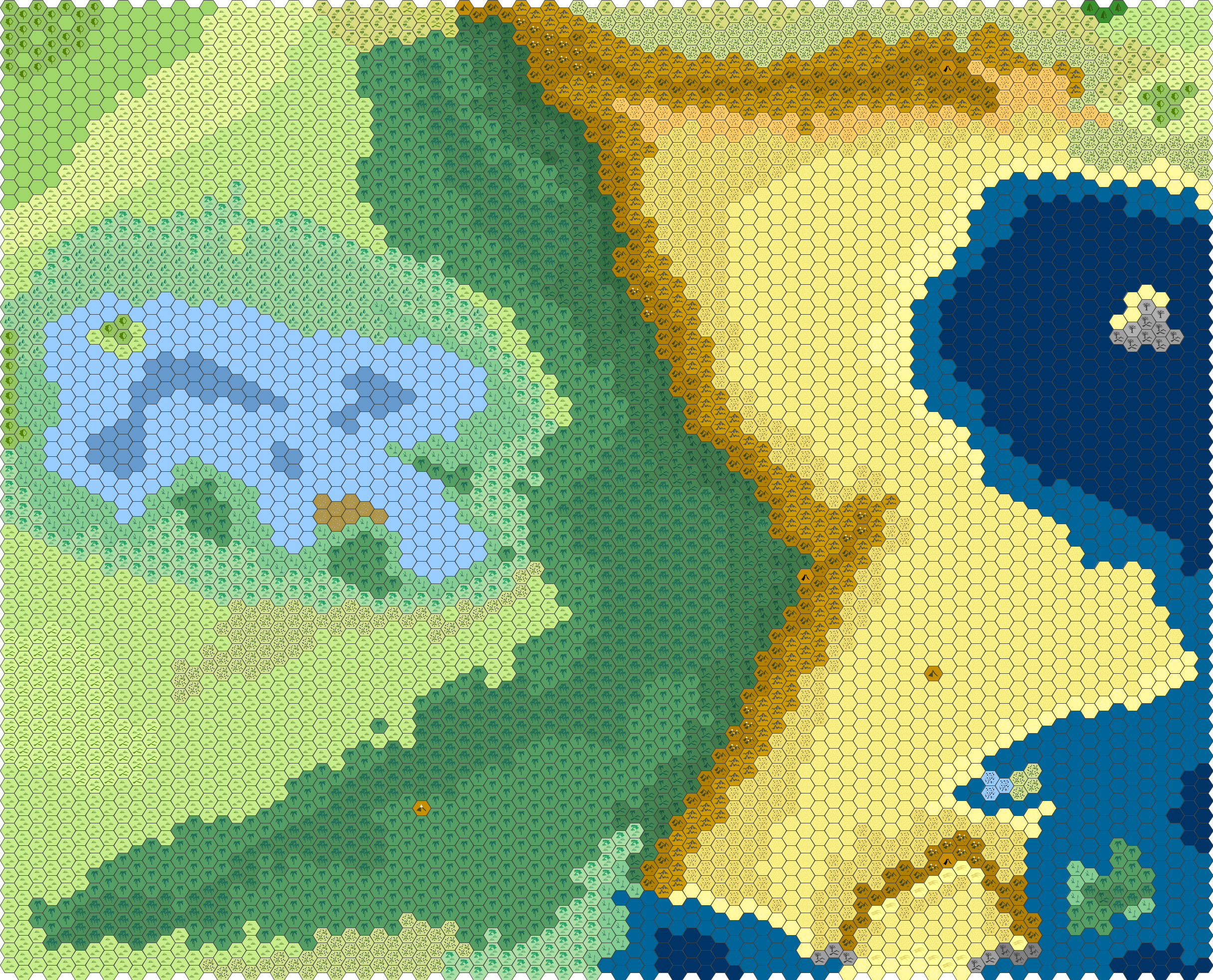
Awesome Gamer Day: Map

For “Awesome Gamer Day” I offer a map. This area will likely be called Tul’Aren in my campaign. A land covered in with thick jungles, wide grassy planes, and steep mountains, curiously cut off from the ocean by an unnatural blasted desert wasteland.

Created by Matt Maranda with Hexographer Pro.


Feel free to use this map in your home games and expect to see me flesh it out more. If people would like a version with hex numbers let me know in the comments.

Monday, July 28, 2014

Fantasy in the Blasted Future

In my last post I talked about setting a "Lamentations of the Flame Princess" game in the future after a catastrophic event. But my description did not go into any detail about what cultures and nations might look like in that world. So here I am writing to further broaden the way different parts of the world devolved yet still mimic the reality that had once been.
Kandah - The cold heavily forested planes of Kandah contain many small remote villages. Hunters, loggers and farmers eke out a meager existence living in constant fear of the long dark nights. To the West as the hardwood forests climb great mountains the villages become larger and farther apart, here miners explore the bones of the earth, wresting riches from the old mines of ages past now the home to thriving colonies of beasts that would be best left undisturbed in their holes. The riches of mining towns make them hubs for foreigners as well as the people from the woods. Moving further north brings travelers to a harsh arctic waste. Few beyond the tribes that live there have returned from those frozen lands and those that do have merely explored its frozen eastern coasts. The treasures and relics that might still exist preserved in that frozen wasteland will make legends of those strong enough to succeed.
Swerzirlind - This land is nestled in and around steep mountains. These mountains serve to insulate the land from predations of the outside world but they they also divide it. This has caused two major factions to vie for power over the people and trades routes. They are the Cantonians and the Zureich, although many other small groups can be found living in remote villages hoping to remain unnoticed by the conscriptors of forces larger than themselves. The largest faction are the agnostic Cantonians, followers of the crown Prince Haldritch Zwingli, who control the trade routes and given recent trouble with religious fanatics have taken to eradicating all organized religion. These actions fueled the ire and ranks of the opposed Zureich. Once just a free city in the heart of Swerzirlind it has become the epicenter for the Church of Monotheism. The Zureich defend their faith militantly with non-believers, unwilling to convert, being executed without need for cause. Other prominent groups vehemently against the dominant factions include Monotheists of the Later Prophets, Monotheists of the First Church, and Monotheists of the Free Orders.
Ghula - Walled holdfasts stand atop natural and manmade hills bastions of safety poking out above the Black Forests of Ghula. These holds frequently war with each other keeping trade and communication across long distances to minimum. While some semblance of a once unified Ghulian people might exist in the language and engineering, each village is a stylized subculture with their own unique take own what it means to be Shulian creating a morass of taboos and etiquettes difficult to master and easy to cross. Blood cults, headhunters seeking to honor or trap the spirit of their enemy to prevent retribution from beyond the grave, and ritualized necrophilia before the deceased are interred are additional horrors villages might have in store for explorers. As if the villages weren't dangerous enough, the untrod paths in the black forests hide worse degenerates and beasts too wicked to be exposed to the light of day.
The Divided Isles of Welschlen - The major island of Welschlen as well as the smaller islands and newly founded island colonies are united under one king, the recently coroneted Kyor of Rutland. But King Kyor does not sit the thrown unchallenged. The Green Isle is fomenting a new bid for freedom. It has rebelled several times throughout the years creating generations of mistrust, harsh laws, and even famines all to keep the people week and subjugated to the Welshlen throne.  Yet these are not the only troubles on the Green Isle, creatures of fairy also lay claim to the islands and they too have gained a strong foothold on the Green Isle and are branching out to the others. Kyor’s predecessors would have cut down such insurrection quickly with iron and fire but the Welschlen squabble internally over who should have been lord. Many support Kyor and his house under the banner of the White Lilly others disenfranchised or slighted by Kyor’s lineage have begun flocking to House Whelles of the Red Carnation. Weakening the will of both houses to remain at war with one another are the savage raiders from the North and West. They strike the Isles without mercy and with the fastest, lightest, and shallowest ships known.
Ravenna – The Empire of Ravenna, is a corrupt nation, any kind of vice can be bought or sold here. The empire has been held together and expanded by generations of strong Emperors and a pragmatic approach to the absorption of cultures and religions. But while every religion is theoretically equal two religions have greater standings with the nobility the Arcane Cult of Ottovacarian Divinity and the Devoted of the Quicksilver Blade. The Arcane Cult of Ottovacarian Divinity are the only wizards tolerated within Ravenna and their religious and arcane magic has been honed to help detect and defeat threats to Ravenna and her rulers. This protection has naturally secured their prominence, protection, and wealth. The Devoted of the Quicksilver Blade are an order of militants that worship and train for war. This makes their devotees the best trained and single minded forces in the empire. Many of in the warrior class are lay adherents, paying for services and advanced training in combat arts. This makes them first in line for promotion and elite duties. It is also rumored that the Devoted have stockpiled and understand the use of weapons from before the fall of civilization and rise of Ravenna.
Sajavedra   – A war torn barely legendary land. Jungles and abandoned rice fields dot the landscape. Meanwhile energies of a war, incomprehensible to the people surviving in the Sajavedra today, leech into these same fields and jungles warping flora and fauna alike. As this blasted and town landscape loses its connection to the world that was petty ancient gods of the land are awakening. Their sleep disturbed by the changes happening around them and the lack of propitiations offered up to them.
Although none of these regions specifically mentions the ruins of fallen civilizations, I've intentionally left that out. What technology or ruins are left is up to the game and much easier to sprinkle into things. But cultures based on history and places takes a little more planning and inspiration which is all I can hope to achieve with this post.

My inspiration for the places and cultures are from many varied sources. Kandah was inspired by Hiero’s Journey as well as the ‘Brave New World’ campaign/adventure. Swerzirlind is Switzerland with a dash of the reformation and theories that Knights Templar hid there to avoid persecution, now after the fall of civilization they return to rebuild civilization under their view after thousands of years.  Welschlen should obviously be the British Isles during the War of the Roses with added rebellion and mythic fey from Ireland. Ghula is Gaul at the peak of the Celtic civilizations. Ravenna was once the seat of the Roman Empire and this is its rebirth. While the Sajavedra if taken whole cloth from Kenneth Hite's Qelong adventure.

Wednesday, January 29, 2014

A Campaign Idea for Lamentations of the Flame Princess

James Raggi the creator of Lamentations has vacillated on the subject of “should a referee use the earth or a new world while running Lamentations of the Flame Princess”. While it has been my experience that most DMs choose to use a fantasy world; there was, especially in the early days of the hobby and the fantasy that inspired it, a tendency to use modern human transported to the fantasy world which was populated by characters out of our world’s myths, legends, and sometimes history.


The argument James makes against using the earth is “People know too much [about history] and not enough about it.” This quote appears in the ‘Referee’ guide from the ‘Lamentations of the Flame Princess: Grindhouse Edition’ of the book. It goes on to explain which some people will know a lot about certain subsets of world history and others will be fairly ignorant of it. Both groups will often have their sense of immersion disrupted and that can be distracting from the game.

While the argument for using the earth is “Remember LotFP is a horrific game, and to make the unearthly elements stand out as particularly unnatural and awful a more mundane setting is required.” which is from the ‘Better than any Man’ the 2013 Free RPG Day adventure. This approach does work well which is why most horror stories take place in and around our world. \


Although both sides have merit there is a third option which is to create take either a character from the modern or historical world and drop them into a world of myth and legend similar to but different from the actual historical world. This allows for them to encounter strange things but still meet people who are "normal" and better yet their basic assumptions of the world's history can still be satisfied while allowing for differences and inconsistencies from the actual past because of "magic"


However, my favorite option which I believe can provide a referee with the benefits of both the freedom of a made-up world wit the implied understanding and 'reality' of the historical world. Set the game in the future 200+ years after a catastrophic event. During that time civilizations fell but people tried to rebuild in the memory of what was. However, these memories can be tarnished or for the good of the appearance of unity and normality dark and terrible things can lurk under the surface. Some communities can be nice and helpful having suffered less while other greedy and savage all the while trying to live up to the glory of the past. This approach to world building was inspired by Jack Vance's "Dying Earth" series and Clark Ashton Smith's "Zothique" cycle. Both however, are set after the world has aged to near extinction and the sun burns a harsh red. The other half of my inspiration came from an unlikely source, the old 'Thundar the Barbarian' with it's humanity crushed under the boot of powerful magicians crossing the line between science and magic, strange beasts and accepted humanoids, it hinted at a darker world ripe to inspire adventures appropriate for LotFP.